
Garlic powder is widely used in food seasoning, sauces, snacks, instant foods, meat products, and spice blends. With growing demand for convenient and shelf-stable garlic products, many food processors are investing in garlic powder processing machines to improve production efficiency, product quality, and hygiene.
So, what machines are used to make garlic powder? A complete garlic powder production line typically includes machines for garic cleaning, peeling, slicing, drying, grinding, sieving, and packaging. The exact equipment configuration depends on production capacity, garlic variety, desired powder fineness, and automation level.
What Machines Are Used to Make Garlic Powder?
A commercial garlic powder production line generally consists of the following machines:
- Garlic cleaning machine
- Машина для очистки чеснока от шелухи
- Garlic separator or sorting machine
- Машина для нарезки чеснока
- Машина для сушки чеснока
- Garlic grinding machine
- Garlic powder sieving machine
- Garlic powder packaging machine
These machines work together to transform fresh garlic bulbs into clean, dry, uniform garlic powder.
1. Garlic Cleaning Machine
The first step is to remove soil, dust, stones, and other impurities from fresh garlic.
A машина для очистки чеснока can use water spraying, bubbling, brushing, or other cleaning methods to remove contaminants from the garlic surface.
For commercial production, continuous garlic washing equipment can help improve cleaning efficiency while reducing manual labor.
Key benefits:
- Removes dirt and impurities
- Improves product hygiene
- Supports continuous production
- Reduces manual cleaning work
- Can be integrated into an automated processing line
2. Garlic Peeling Machine
After cleaning, the garlic bulbs need to be separated and peeled. Garlic peeling is one of the most important stages because complete and gentle peeling directly affects the quality of the final powder.
A машина для очистки чеснока от шелухи uses pneumatic or mechanical peeling technology to remove the garlic skin while minimizing damage to the cloves.
For large-scale garlic powder production, an automatic garlic peeling machine can provide higher processing efficiency than manual peeling.
3. Garlic Sorting Machine
After peeling, the garlic cloves can be inspected and sorted to remove damaged, discolored, or unqualified cloves.
A sorting machine can help ensure that only suitable garlic enters the slicing and drying stages.
For high-quality garlic powder production, sorting is especially useful when raw garlic quality varies between batches.
4. Garlic Slicing Machine
Peeled garlic cloves are usually sliced before drying. Garlic slices have a larger surface area than whole cloves, allowing moisture to be removed more efficiently.
A машина для нарезки чеснока can produce relatively uniform slices, which helps achieve consistent drying results.
Uniform garlic slices are important because slices that are too thick may require longer drying times, while very thin slices can dry too quickly or become difficult to handle.
5. Garlic Drying Machine
Drying is a critical stage in garlic powder production. The sliced garlic must be dried to a suitable moisture level before grinding.
Industrial garlic drying machines can provide controlled temperature, airflow, and drying time. Depending on the production requirements, processors may choose hot-air drying systems, heat pump dryers, or other industrial drying technologies.
Proper drying helps:
- Reduce moisture content
- Extend product shelf life
- Prevent mold growth
- Improve grinding efficiency
- Preserve garlic flavor and aroma
The drying temperature should be carefully controlled because excessive heat may negatively affect the color, flavor, and quality of garlic.
6. Garlic Grinding Machine
Once the garlic slices are sufficiently dried, they are transferred to a машина для измельчения чеснока.
The grinder breaks the dried garlic into smaller particles and produces garlic powder. Industrial grinders can be configured according to the desired particle size and production capacity.
For commercial garlic powder manufacturing, the grinding system should provide stable particle size and continuous operation.
7. Garlic Powder Sieving Machine
After grinding, the garlic powder may contain particles of different sizes. A garlic powder sieving machine separates coarse particles from fine powder.
The qualified powder can pass through the screen, while oversized particles can be returned to the grinding system for further processing.
This process helps produce garlic powder with a more uniform particle size.
8. Garlic Powder Packaging Machine
The final step is packaging the garlic powder.
An automatic garlic powder packaging machine can accurately weigh and fill the powder into bags, pouches, jars, or other containers.
Depending on the product and target market, packaging systems can include:
- Automatic weighing
- Powder filling
- Bag forming
- Sealing
- Date coding
- Labeling
Proper packaging protects garlic powder from moisture, contamination, and oxidation during storage and transportation.
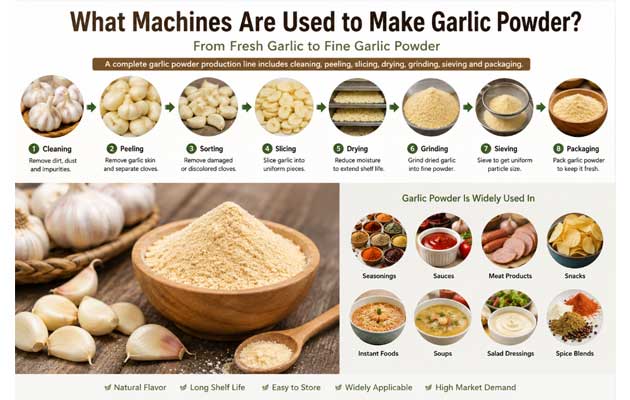
garlic powder processing machine
A typical industrial garlic powder processing flow is:
Fresh Garlic → Cleaning → Peeling → Sorting → Slicing → Drying → Grinding → Sieving → Packaging
For small-scale production, some processing steps can be performed manually. However, a fully automated line is more suitable for factories with high production volumes.
How to Choose Garlic Powder Processing Machines?
When selecting garlic powder processing equipment, manufacturers should consider several factors.
Production Capacity
Determine how many kilograms or tons of fresh garlic need to be processed per day. Machine capacity should match the actual production requirement.
Degree of Automation
Small processors may use semi-automatic equipment, while larger factories can choose a fully automatic garlic powder production line to reduce labor requirements.
Garlic Powder Fineness
The required powder particle size determines the type of grinding and sieving equipment needed.
Drying Requirements
Drying capacity is particularly important because moisture content directly affects the quality and shelf life of garlic powder.
Food Hygiene
Food-contact components should use appropriate food-grade materials, such as SUS304 stainless steel, to facilitate cleaning and meet food processing hygiene requirements.
How Much Does a Garlic Powder Production Line Cost?
The cost of a garlic powder processing line varies significantly depending on production capacity, automation level, machine configuration, drying technology, packaging requirements, and other factors.
A small garlic powder production setup may require only basic peeling, slicing, drying, and grinding equipment. A large industrial factory may require a complete automated line with cleaning, peeling, sorting, drying, grinding, sieving, and packaging systems.
Therefore, it is better to select equipment based on the required capacity, garlic type, final powder specifications, and factory layout rather than choosing machines based only on price.
Benefits of Using a Garlic Powder Processing Line
Investing in a commercial garlic powder processing line can provide several advantages:
- Повышение эффективности производства
- Сниженные затраты на рабочую силу
- More consistent garlic powder quality
- Better processing hygiene
- Stable moisture control
- Uniform powder particle size
- Easier production management
- Suitable for large-scale commercial production
Frequently Asked Questions
What machine is used to make garlic powder?
A complete garlic powder production line normally uses a garlic cleaning machine, peeling machine, slicing machine, drying machine, grinding machine, sieving machine, and packaging machine.
Can fresh garlic be directly ground into powder?
Fresh garlic contains high moisture and is generally not suitable for direct grinding into stable powder. The garlic should first be sliced and properly dried before grinding.
What is the most important machine in garlic powder production?
The drying machine is particularly important because the moisture content of dried garlic directly affects grinding performance, shelf life, flavor, and final powder quality.
Can garlic powder production be fully automated?
Yes. A complete industrial garlic powder production line can integrate cleaning, peeling, sorting, slicing, drying, grinding, sieving, and packaging processes for continuous and automated production.
How can I choose the right garlic powder production line?
Consider your raw garlic availability, required production capacity, desired powder fineness, drying method, automation requirements, available factory space, and packaging specifications before selecting equipment.
Заключение
Making garlic powder on a commercial scale requires more than just a grinding machine. A complete линия обработки чесночного порошка combines cleaning, peeling, slicing, drying, grinding, sieving, and packaging equipment to efficiently convert fresh garlic into high-quality powder.
For manufacturers planning to start or expand a garlic powder business, choosing the right equipment configuration can improve production efficiency, product consistency, and long-term operating performance. The best solution should be customized according to raw material characteristics, production capacity, final product requirements, and investment budget.